Dashboards & Pulse
RevOps reporting as a service: one agreed view of spend, leads and revenue, and a pulse in Slack each morning.
Built in your own accountsA person approves client reportsHanded over with a runbook
3 workstreams that give you one number everyone trusts:
 Revenue · One agreed view
Interactive example · demo data
Revenue · One agreed view
Interactive example · demo data
Last 7 days · all sources
Sync status · last refresh per source
- Meta AdsSynced 07:52
- Google AdsSynced 07:53
- GA4Stale · 02:10
- HubSpotSynced 07:55
- StripeSynced 07:56
#leadership · Daily pulse, yesterday
- Spend$412Meta $236 · Google $176
- Leads11$37 each
- Booked3calls
- Revenue$1,380from Stripe
- GapGA46 h behind · shown as stale
Teams that run on AiXCEL systems







Connects to the tools you already use
- Meta Ads
- Google Ads
- GA4
- HubSpot
- HighLevel
- Stripe
- Slack
- Google Sheets
- Gmail
- Supabase
- Airtable
- n8n
One agreed view
A fixed-scope build in your own accounts. We agree the metric dictionary and source inventory, reconcile the numbers, then wire one dashboard and one Slack pulse on top, so spend, leads and revenue mean the same thing to everyone.
Choose your use case
What gets built
- An agreed metric dictionary and source inventory
- Scheduled collection and normalization for a bounded dataset
- A dashboard with freshness indicators
- Checks for missing, duplicate and inconsistent records
Sources
Reconcile
Reconcile & defineMetric definitionsDe-duplicationAttribution rulesWarehouse
Dashboard + Slack
Source dates on every numberDaily pulse in Slack
The agreed numbers arrive where your team already works. Pulse, the module that sends them, is delivered inside this service rather than as a standalone product. A short pulse each morning, an alert when a metric leaves its range, and weekly reports that wait for a person to approve them.
- 08:00
Daily pulse
Yesterday's spend, leads, bookings and revenue land in the channel your team already reads.
Internal - Any time
Anomaly alert
When a metric breaks its agreed range or a source stops refreshing, the owner is pinged with what changed.
Internal - Monday
Weekly report draft
A weekly report is drafted per team or per client from the same agreed numbers.
Draft only - Before sending
A person approves
Nothing goes to a client until a person has read and approved it.
Person approves - Month end
Month-end summary
A month-end summary of spend, leads, bookings and revenue, with notes on any data gaps.
Internal
Client-facing reports always wait for a person to approve themEvery step runs on a schedule
One pulse, one place
Each morning the team gets a short summary: what was spent, what came in, what booked and what earned. If a source is late, the pulse says so instead of quietly leaving it out.
#leadership · Daily pulse, yesterday
- Spend
- $412
- Leads
- 11
- Booked
- 3
- Revenue
- $1,380
GA4 refreshed 6 h late, so it is marked stale.
- Spend, leads, bookings and revenue on one set of definitions
- Freshness shown for every source
- An owner named on every alert
Agreed range $30 to $45Outside the range
Cost per lead is $58, above the agreed $30 to $45 range.
Spend rose while leads stayed flat. Owner: Sam. Source dates attached.
Client reports for agencies
A report per client each week, drafted from the same agreed numbers and approved by a person before it is sent. Your team reviews instead of rebuilding the same report by hand.
Weekly reports, drafted for you to approve
Every Monday a report is drafted for each client. A rep reads it, edits it and approves it. The AI never sends a client report on its own, and each client can have a private results dashboard.
- One drafted report per client, every week
- The same metric definitions across every client
- A private results dashboard per client
- Reps approve before anything is sent
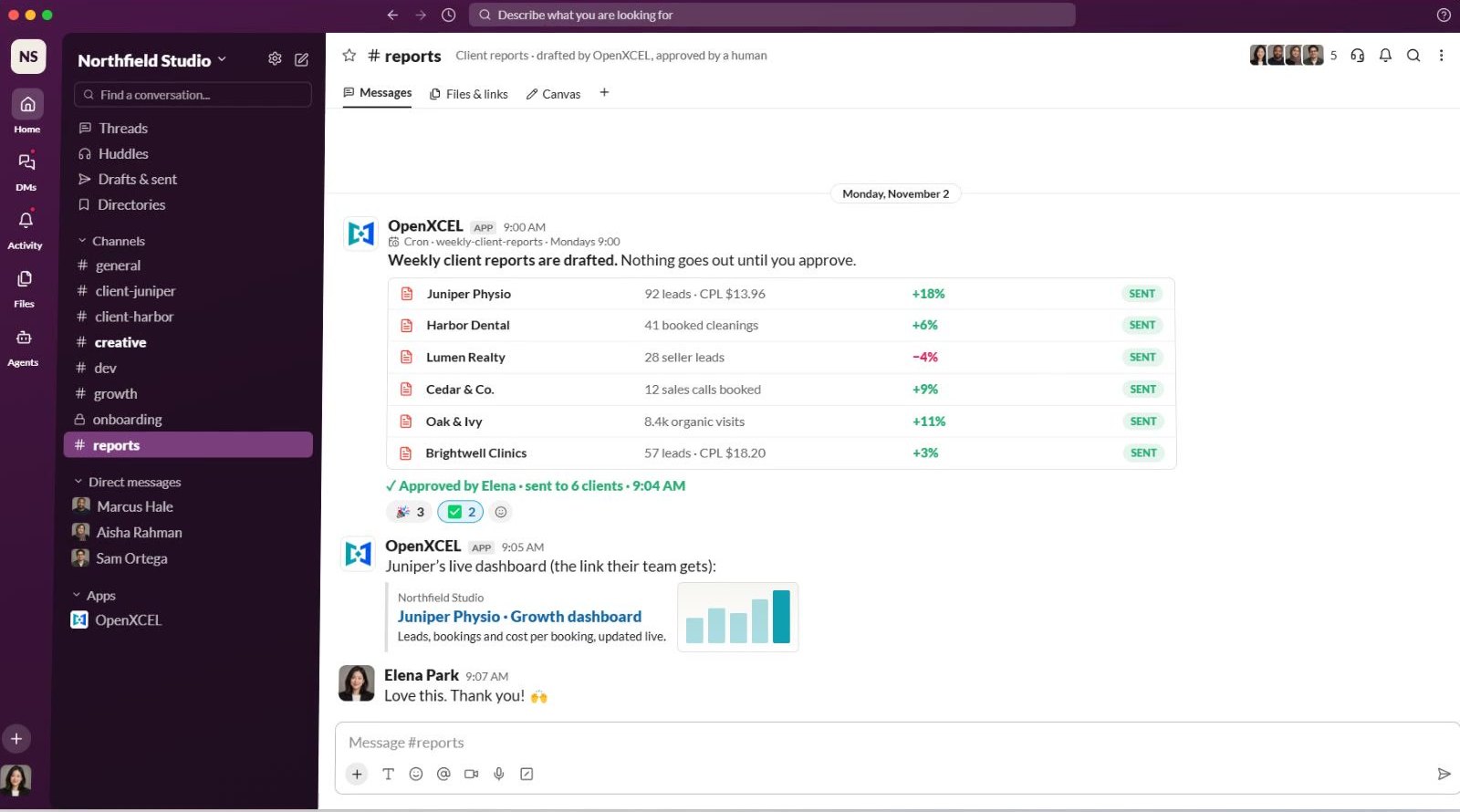
From the OpenXCEL product, with sample clients. Weekly reports are drafted, then approved by a human.See OpenXCEL AI
US healthcare-marketing agency
Clinic growth agency- A Facebook Ads daily sync into Supabase
- Weekly client reports drafted as Gmail drafts for reps to approve
- A private client results dashboard
Hrmny
Creative agency · Dubai & Riyadh- A commercial dashboard: won deals against target, pipeline and funnel
- Health and failure alerts when something breaks
How an engagement runs
Sprints are fixed-scope and priced before we start. Every engagement follows the same path, built in your accounts and handed over.
- 01
Map the decisions
Thirty minutes with Ahmad. We list the decisions your reporting should support, the sources behind them and who owns each number.
- 02
Agree the definitions
A written metric dictionary and source inventory: what counts as a lead, a booking and revenue, and which attribution rules apply.
- 03
Build in your accounts
Scheduled collection, one dashboard and one Slack pulse. A person approves anything that goes to a client.
- 04
Test the gaps
We reconcile a sample number to its source and simulate a missing refresh, to confirm the report shows the gap instead of hiding it.
- 05
Hand over
The keys, a runbook, an operating checklist and training. Ongoing monitoring and improvements are scoped separately.
Frequently asked questions
What if a data source is late or missing?
The gap is shown, not hidden. A stale or missing source is flagged with its last refresh date on the dashboard and in the pulse. Different date ranges and definitions are never combined silently, and every number can be traced back to its source.
Which tools does it connect to?
Typically Meta Ads, Google Ads, GA4, HubSpot or HighLevel, Stripe, Slack and Google Sheets. Often the first improvement can use your existing platforms and APIs, so you do not have to replace anything. Tool changes are considered only when the current setup cannot meet the agreed requirements.
Who owns the dashboard and the data?
You do. It is built inside your accounts and handed over with the keys, a runbook, an operating checklist and training. Ongoing monitoring, improvements and support are scoped separately.
Can the AI send reports to our clients on its own?
No. External actions need explicit authorization and tested rules. Reports are drafted, a person reviews and approves them, and only then do they go out. Drafting, review and execution stay separate steps.
What happens before you quote, and how is it priced?
We review the workflow, its owners, the tools involved and the access needed. The proposal then defines the scope, assumptions, responsibilities and acceptance criteria. The one agreed view is a fixed-scope sprint priced before we start; the daily pulse and client reports run as subscriptions.
Schedule a workflow mapping call
Thirty minutes with Ahmad. We map where your numbers disagree today and what one agreed view would take.
Book a workflow mapping call