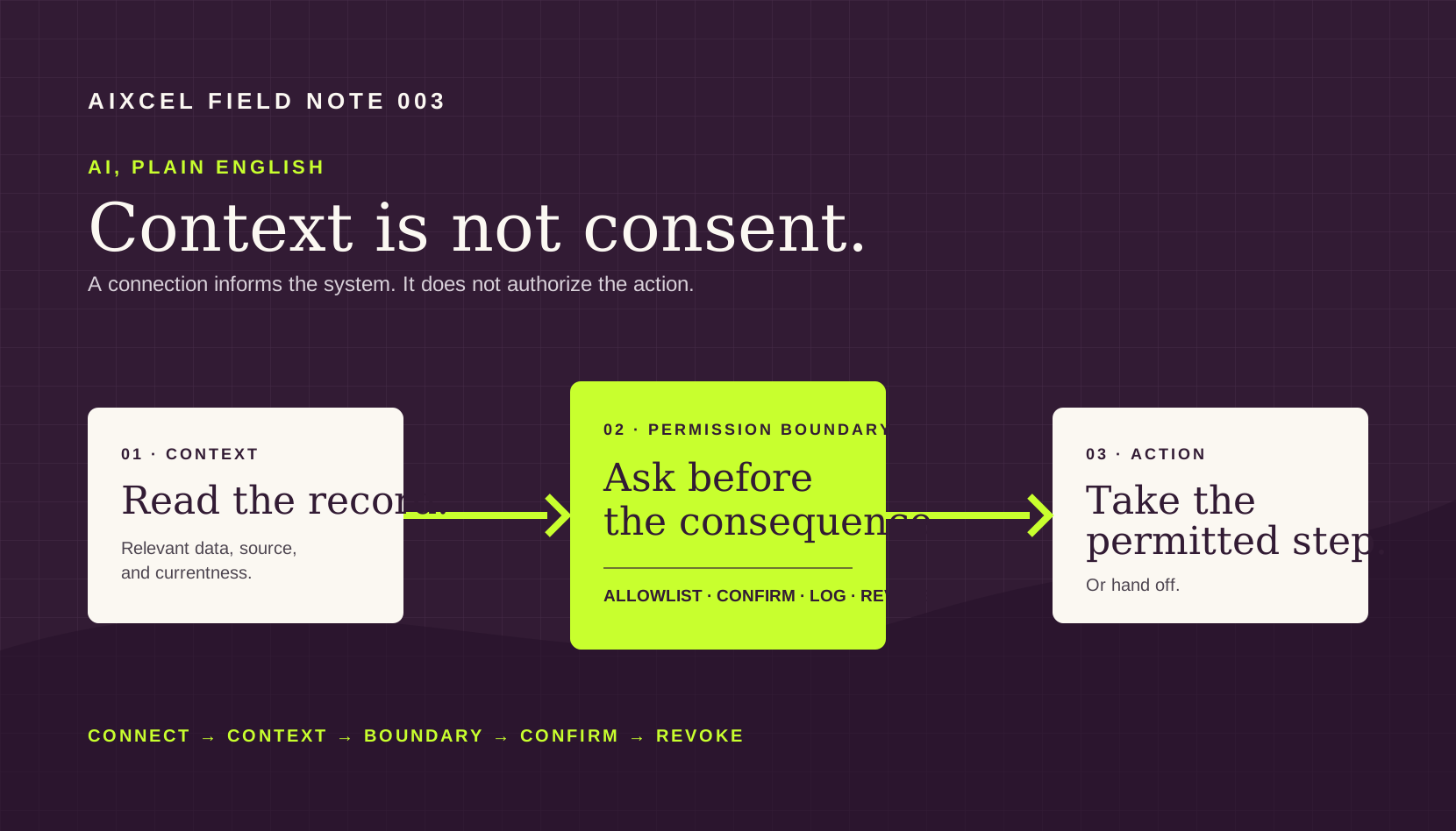
 Ahmad Bukhari · Field Series
Key takeaways
- A connected data source gives an AI context; it does not automatically grant authority to change, disclose, spend, send, or decide.
- A production workflow needs five visible steps: Connect, Context, Boundary, Confirm, and Revoke.
- Start with read access and one reversible, policy-bounded action; name an owner for exceptions before widening the scope.
- This article draws an operating lesson from a consumer-health launch. It does not assess the product’s clinical, legal, security, or regulatory suitability.
What the announcement establishes, and what it does not
On 23 July 2026, OpenAI announced Health in ChatGPT. The company says logged-in U.S. users aged 18 and older can connect Apple Health and supported medical records on web and iOS, and that Health information is not used to train its foundation models or target ads. OpenAI also says ChatGPT asks for permission by default before using connected Health information to personalize a response.
Those are product facts from OpenAI, not a transferable implementation guarantee. OpenAI says the experience does not replace qualified medical judgment, and the rollout, connected sources, permissions, and availability are all product-specific. A business should verify its own jurisdiction, contracts, data categories, integration behavior, and controls before using any comparable pattern.
The transferable lesson is narrower and useful: context and authority are different system states. A source connection can make an AI more informed. It should not silently expand what the AI is allowed to do with that information or on the user’s behalf.
The five-step permission loop
A reliable AI workflow makes the transition from information to action explicit. The simplest useful model is Connect, Context, Boundary, Confirm, and Revoke. It is not a compliance framework by itself. It is a way to stop a convenient integration from becoming an unowned decision path.
- Connect: specify the source, account, data categories, purpose, and retention expectations. Do not treat a broad OAuth grant as a business rule.
- Context: define what the model may retrieve or summarize. Keep source provenance and the currentness of the record visible to the user or operator.
- Boundary: map allowed, prohibited, and human-only actions. A useful default is read access before any write access.
- Confirm: require a fresh confirmation before an external, irreversible, sensitive, or financially consequential action. The confirmation should state the object, outcome, and destination.
- Revoke: let a person disconnect the source, reduce the scope, stop a workflow, and find the audit trail without filing a support ticket.
Worked example: customer support with private account context
Consider a support agent connected to a customer account, subscription, order history, and service tickets. The connection may let the agent explain the current plan, summarize recent cases, and surface the next delivery date. That is useful context. It is not permission to change the account owner, disclose details to an unverified caller, cancel a contract, or issue an unbounded credit.
A controlled first release could permit the agent to retrieve a verified customer’s order status, create a support case, and resend an existing invoice. It could require confirmation to change a delivery address before fulfilment, and it could stop for a named human owner when the request involves refunds above a defined value, account recovery, a complaint, or a policy exception.
The design target is not a chatbot that sounds certain. It is a service path in which the permitted action, the identity check, the confirmation, the exception owner, and the audit record are all testable. If an operator cannot show those things, the system is carrying more authority than the organisation can govern.
Controls to design before an AI can act
Start with the smallest route that creates a measurable customer or operational benefit. Then make its controls visible in the workflow, not only in a policy document.
- Identity and source: verify the actor, use the minimum data scope, record the system of record, and handle stale or conflicting data deliberately.
- Action policy: maintain an allowlist of actions, thresholds, prohibited outcomes, and a named exception owner. Model confidence is not an authority boundary.
- Confirmation: distinguish between a request to inspect information and a request to disclose, change, send, spend, or commit. Ask again when the consequence changes.
- Recovery: give operators a clear stop control, replay or rollback where possible, and a human queue with enough context to resolve the case.
- Evidence: log the source used, rule applied, action proposed or taken, user confirmation, handoff, and result. Review samples and exceptions against a defined evaluation set.
Opportunities, risks, and who should act now
This pattern can improve response speed, reduce repeated data gathering, and give people better context at the moment they need to decide. It is particularly useful in support, sales operations, service delivery, and internal coordination where a bounded action can remove routine work without hiding consequential decisions.
The risks are equally practical: a weak identity check can expose information; stale context can produce the wrong action; a broad tool permission can turn a suggestion into a commitment; and a missing audit trail can make a failure impossible to diagnose. Privacy, consumer protection, security, employment, sector, and cross-border rules may add requirements that this article does not cover.
Act now if you have one repeatable workflow, reliable source data, a named owner, a low-risk starting action, and a way to evaluate the result. Wait if policies change weekly, records conflict, the first action is high stakes, or no one owns the exception queue. In that case, map the process and decision rights before connecting more systems.
A practical 30/60/90-day implementation plan
Days 1 to 30: choose one bounded workflow and make the permission map. List data sources, data categories, identity checks, allowed and prohibited actions, confirmation moments, exception owners, retention, and the evidence that proves a correct outcome. Capture baseline volume, completion time, error or re-contact rate, and manual effort.
Days 31 to 60: build the controlled slice. Connect the minimum source data, start read-only where possible, and add one reversible action behind a clear policy. Test normal, ambiguous, adversarial, stale-data, permission-denied, and revoke scenarios. Review every exception and sample completed work against the acceptance criteria.
Days 61 to 90: release with observability, then expand one boundary at a time. Compare outcomes with the baseline, inspect confirmation and exception patterns, version the action policy, and give the operating owner a tested stop and recovery path. Do not turn a successful read-only pilot into broad write authority in one jump.
Questions decision makers ask.
Clear answers before a platform choice becomes an operational commitment.
01Does connecting a source mean the AI can act on it?+
No. A connection provides a technical path to data or tools. The organisation still needs an explicit policy for what may be read, changed, disclosed, sent, approved, or escalated.
02What is the safest first action for an AI workflow?+
Usually a read-only or reversible task with reliable data, a clear success criterion, and a visible human exception path. The correct choice depends on the workflow and its consequences.
03When should the system ask for confirmation?+
Before a new or consequential step such as disclosure, an external message, a record change, a financial commitment, or an irreversible action. State exactly what will happen before the user confirms.
04Can this article be used as medical or legal advice?+
No. It is a business implementation note inspired by a product announcement. Health, privacy, security, legal, compliance, and sector-specific decisions need qualified review for the relevant context.